10 Best SEO.ai Alternatives Worth Trying
You are paying for an AI writer that keeps missing the mark. Maybe the output needs heavy editing, or your credit balance drains faster than the articles get published. That frustration sends most people hunting for alternatives.
This article compares ten options on features, pricing, and output quality, then shows you which one fits your workflow. By the end, you will know exactly which SEO.ai alternative to try first, and why Autoblogging.ai earns the top spot.
What to Look For in SEO.ai Alternatives
When evaluating SEO.ai alternatives, focus on five core dimensions: content quality, keyword research depth, optimization features, pricing scalability, and integration capabilities. These criteria separate tools that genuinely support search engine optimization from those that simply generate text and leave the hard work to you.
The ideal platform balances AI writing with SEO optimization in a single workflow. A tool that drafts articles but offers no keyword guidance or SERP analysis forces you to stitch together multiple subscriptions, which adds cost and friction.
Pricing matters just as much as features. Some tools charge per credit, others use flat monthly tiers, and a few scale pricing by seat or word volume. Understanding how each model grows with your output helps you avoid surprises once your content marketing ramps up.
Finally, consider how well a tool fits your existing stack. Integrations with CMS platforms, rank trackers, and analytics dashboards reduce manual copying and keep your blog optimization consistent. Research suggests that teams juggling disconnected tools lose time on repetitive tasks that automation could handle.
Key Features, Pricing, and Output Quality Compared
Compare alternatives on features like AI writing modes, SERP analysis, keyword integration, and pricing tiers to determine which tool delivers the best value for your specific needs. The table below outlines the general criteria worth scoring before you commit to any subscription.
| Criterion | What to Check |
|---|---|
| AI writing modes | Long-form article generation, outlines, rewrites, and tone control |
| Keyword research | Search volume data, difficulty scores, and related term suggestions |
| Competitor analysis | SERP breakdowns showing what top-ranking pages cover |
| Content optimization | On-page SEO scoring, NLP term suggestions, readability checks |
| Pricing model | Credit-based, subscription, or hybrid with clear scaling limits |
On features, the must-haves include AI article generation, keyword research, competitor analysis, and content optimization. A backlink checker or rank tracker is a bonus, but the core writing and optimization loop should work well before you pay for extras.
Pricing models vary widely. Credit-based plans suit occasional publishers who want flexibility, while subscription tiers reward teams producing content every week. Typical entry tiers for AI writing tools sit in the low monthly range, with higher plans unlocking more words, seats, or optimization credits.
Output quality deserves close attention. Readability, SEO-friendliness, and originality all matter, and the best tools produce drafts that need light editing rather than full rewrites. Look for natural language processing that understands search intent, not just keyword density. Testing a free trial or sample output is the fastest way to judge whether the writing sounds human enough for your audience.
Scalability ties everything together. A tool that works for ten articles a month may become expensive or cumbersome at a hundred. Check whether pricing grows linearly, whether unused credits roll over, and whether the platform supports multiple users without per-seat penalties that punish collaboration.
1. Autoblogging.ai - Best Overall
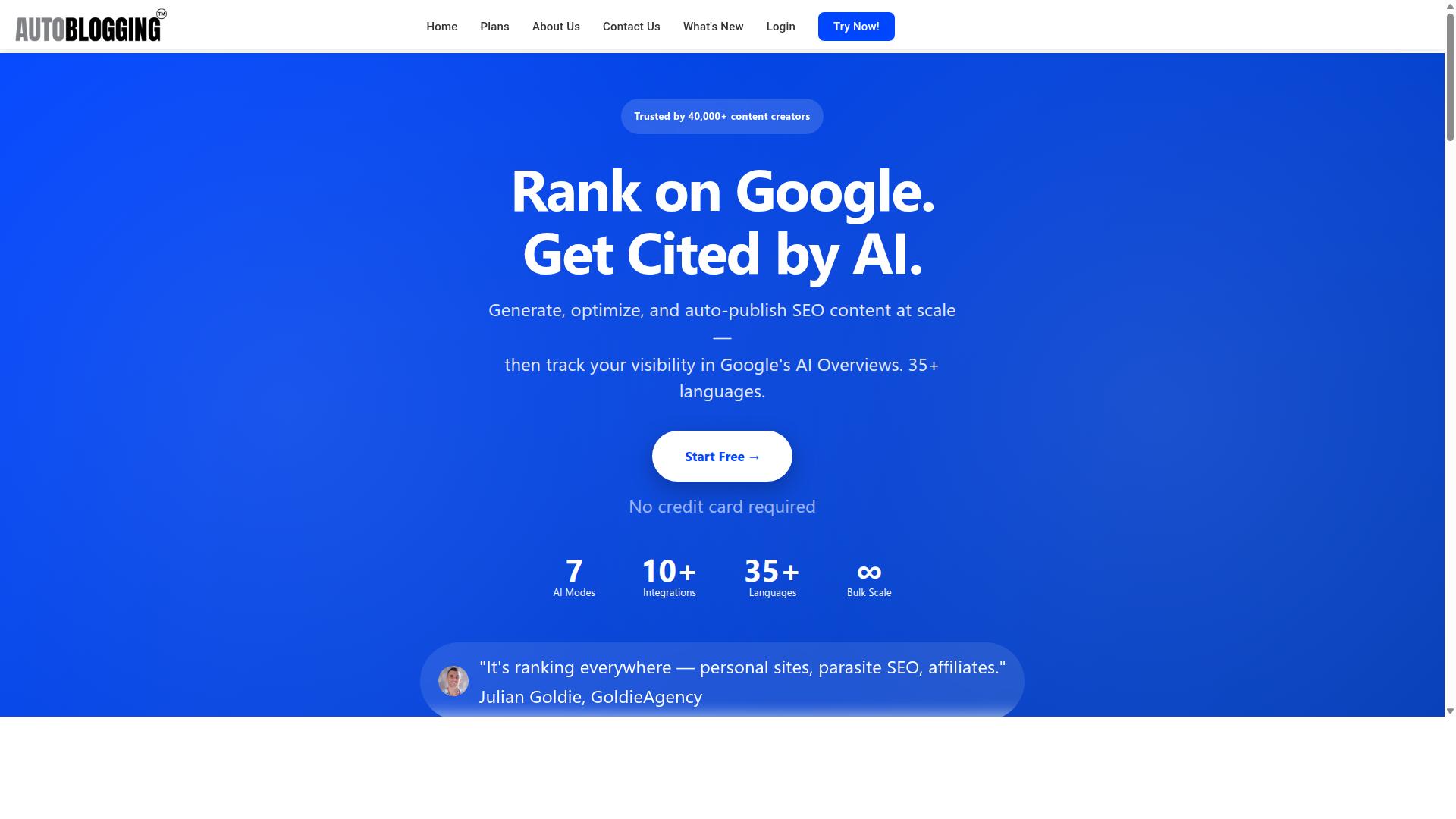
Autoblogging.ai stands out as the best overall SEO.ai alternative due to its robust AI article generation, extensive language support, and scalable pricing. It is trusted by 40,000+ content creators and has generated over 1M+ articles, with a 4.9 average rating to match.
What separates it from most AI writing tools is the range of modes behind a single subscription. The platform ships with 10+ AI modes and support for 35+ languages, so a solo blogger in one market and a multi-region agency can both work from the same account without juggling separate tools.
Publishing is handled end to end as well. One-click WordPress publishing covers unlimited sites, and content can also go out to Web 2.0 platforms and multi-platform destinations. For teams running search engine optimization at scale, that removes a manual export-and-paste step from every article.
The toolset extends past drafting into content optimization. SERP competitor analysis, semantic SEO tools, a 21-point SEO audit, and featured snippet optimization all sit inside the same platform, which matters when AI writing tools are judged on ranking outcomes rather than word count alone. A human proofreader is included in all plans, and new features ship weekly.
Modes, Pricing, and Who It's For
Autoblogging.ai offers multiple AI writing modes, including Quick Mode for free single articles and Godlike Mode for in-depth SERP analysis, with pricing plans starting at $19 per month. The mode you pick depends on how much research depth a piece needs.
- Quick Mode: free, single article and wizard options for fast drafts
- Godlike Mode: SERP competitor analysis, LSI keywords, and knowledge graph extraction
- Bulk Generation: up to 500 articles via CSV
- News Mode: Google News integration
- Amazon Reviews Mode: for product-focused content
Pricing scales with credit volume, and credits roll over so unused capacity is not lost between cycles. Annual plans are available for teams that want to commit longer term.
| Plan | Monthly Price | Credits |
|---|---|---|
| Starter | $19 | 40 |
| Regular | $49 | 120 |
| Standard | $99 | 300 |
| Gold | $179 | 600 |
| Premium | $249 | 1,000 |
| Enterprise | $999 | 5,000 |
The intended audience spans bloggers, website owners, SEO professionals, marketing agencies, content creators, and affiliate marketers. Beginners can start on Quick Mode at no cost, while agencies producing at volume can move into Bulk Generation and higher tiers. Support runs 24/7, and integrations cover WordPress, Shopify, Wix, Webflow, Blogger, and Ghost, plus API, Zapier, and n8n for teams wiring content into existing workflows.
2. Koala AI
Koala AI is a popular alternative known for its user-friendly interface and efficient bulk content generation capabilities. It is built around two main components: Koala Writer, an SEO-focused AI writer, and Koala Chat, a chatbot for lighter conversational tasks. Together they cover the core needs of bloggers, affiliate marketers, and niche site publishers who publish at volume.
The platform's biggest draw is one-click article generation. Instead of building every post from scratch, you enter a topic or keyword and receive a publish-ready draft that is already structured for search. For anyone managing multiple sites, that speed matters more than fine-grained manual control.
Koala AI also supports Amazon affiliate articles, a useful niche for product review sites. Tone-of-voice options and custom outlines let you shape the output before generating, so the draft fits your brand rather than sounding generic.
Other notable features include:
- SEO-optimized article output designed for search visibility
- Bulk generation for producing multiple drafts at once
- Custom outlines to guide structure and headings
- Tone-of-voice settings for brand consistency
- Google Sheets integration for managing content workflows
Pricing is positioned as accessible, with public materials noting prices starting at $9 and a 5000-word free trial. Those figures come from the vendor's own marketing, so it is worth confirming current terms directly before committing.
The trade-off is depth. Reviews of the interface describe it as basic, and Koala Chat is generally seen as less capable than the writer itself. For high-volume blogging and affiliate content, that trade-off is often acceptable. For teams needing deeper content optimization or advanced natural language processing controls, other tools in this list may fit better.
Koala AI suits SEOs and niche site publishers who want fast, affordable drafts with minimal setup. It is a strong fit for solo bloggers and small teams, less so for enterprises needing extensive collaboration features.
3. Agility Writer
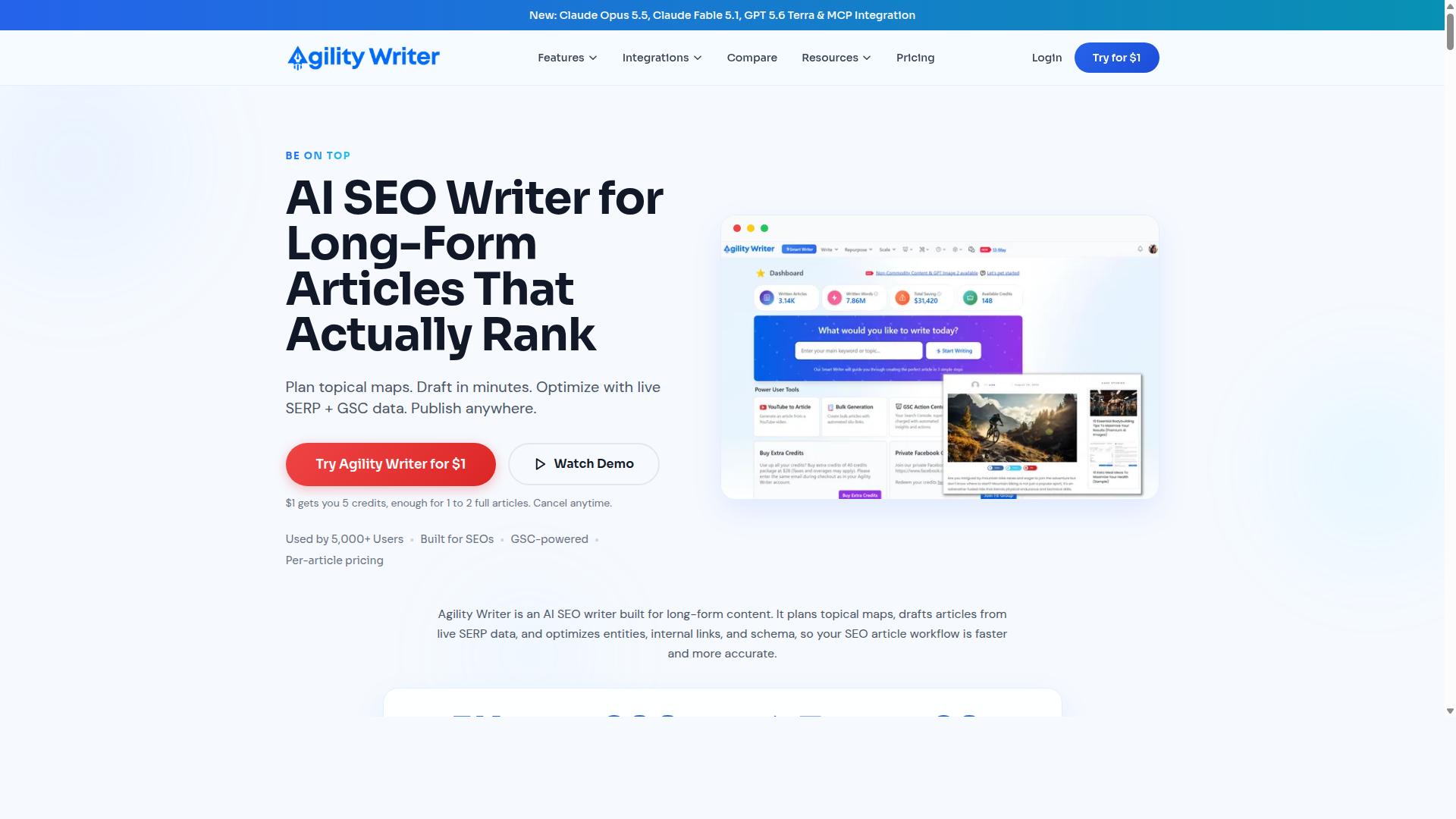
Agility Writer focuses on generating long-form, SEO-optimized content with features like real-time SERP analysis and NLP integration. It is built for writers who want drafts that already reflect what is currently ranking, rather than generic text that needs heavy rewriting.
The tool positions itself as an AI SEO writing solution rather than a general-purpose assistant. It generates articles for blog posts, product reviews, and roundup reviews, and it aligns its output with Google's Helpful Content Update guidance. That focus makes it a natural fit for content marketing teams that publish at volume.
One of its more distinctive angles is planning. Agility Writer can map out topical clusters before drafting, which helps SEO professionals build internal linking structure and cover a subject from multiple angles instead of chasing single keywords.
Key Features and Workflow
The feature set leans heavily toward production speed and editorial control. Writers can move from a keyword or brief to a structured draft, then refine it inside the same environment.
- Bulk Generation for producing multiple articles in one pass
- Smart Writer and Smart Editor for drafting and revising
- Fact Sheets to keep claims grounded during generation
- G-Smart Optimizer for on-page SEO alignment
- Topical Authority Audit to spot coverage gaps
- GSC Action Center for Search Console driven decisions
- Smart Visual AI and Social Posts for repurposing output
There are also Templates and Writing Modes, which let users match tone and structure to a specific format. The MCP Connector and integrations with Claude, ChatGPT, Cursor, WordPress, API, and Zapier extend where the content can go next.
Who It Suits
Agility Writer is commonly used by content agencies and SEO professionals managing several client sites at once. Affiliate marketers tend to like it as well, since review and roundup formats are baked into the workflow.
Pricing is straightforward to evaluate. It offers a $1 trial with 3 credits for 3 articles, and there is no free trial beyond that. Testing it on one real brief is usually enough to judge whether the SERP-driven drafting matches your editorial standards.
As an SEO.ai alternative, it earns its place for teams that care about topical authority and structured production. If your priority is a steady pipeline of optimized long-form content, it is worth a look.
4. SEOWriting.ai
SEOWriting.ai is designed to automate content creation with a strong emphasis on SEO, offering features like keyword integration and bulk generation. It sits in the same category as other AI writing tools built for search-focused publishing rather than general copywriting.
The platform leans toward speed and volume. Instead of drafting one post at a time, users can produce articles in batches, which makes it a practical pick for content marketing teams managing multiple sites or large editorial calendars.
Its other notable strength is publishing workflow. According to publicly available information, SEOWriting.ai supports WordPress integration with one-click generation and auto-posting, so content can move from draft to live site with minimal manual steps.
For anyone weighing SEO.ai alternatives, this tool fits bloggers, affiliate publishers, and marketers who care more about output volume and on-page basics than about deep editorial control.
Typical use cases include:
- Bulk article generation for niche or multi-site blogs
- Keyword-driven drafts that need light editing before publishing
- Auto-posting directly to a WordPress site
- Producing content in multiple languages for regional audiences
Pricing is one of its more accessible points. The free plan offers 3 free articles up to 25,000 words, which gives new users a way to test output quality before committing. Paid tiers scale from there, though exact limits vary by plan.
Where it may fall short is fine-grained content optimization. Tools in this space differ in how much they support SERP analysis, competitor analysis, or NLP-driven scoring, so it pays to check whether the editor matches how you actually work.
If your priority is publishing steadily without a heavy manual lift, SEOWriting.ai is worth a look. If you need deeper optimization controls, compare it against the other entries on this list first.
5. Scalenut

Scalenut combines AI writing with SEO research, offering tools for keyword planning, content optimization, and competitor analysis. It positions itself as an all-in-one platform where planning, research, creation, and optimization happen in one place. That unified approach appeals to teams that want fewer tools in their stack.
The platform is built around NLP-powered optimization, which analyzes top-ranking pages and helps writers align drafts with what search engines reward. Instead of guessing at structure and phrasing, users get guidance while they write. This makes it a practical fit for content optimization workflows.
Scalenut targets agencies and businesses rather than solo hobbyists. Its feature set suggests a focus on repeatable production, the kind of output that supports ongoing content marketing programs. Teams juggling multiple clients or brands tend to value that consistency.
Beyond writing and optimization, the platform includes keyword planning and competitor analysis. Those capabilities support the early stages of a campaign, when topic selection and gap analysis matter most. Having research and drafting in one environment reduces handoffs between tools.
Scalenut also lists GEO tracking, AI visibility tracking, prompt insights, citation tracking, and AI traffic signals. A GEO Action Center, Social Upreach, and a Backlinks Marketplace round out the offering. These features point to a growing emphasis on visibility beyond traditional search results.
It suits SEO teams, marketers, and agencies focused on SEO and GEO content workflows. Public pages mention a free course, free tools, and a free AI audit, though no pricing is stated. Buyers should check current details directly.
For anyone comparing SEO.ai alternatives, Scalenut is worth a look if you want research and writing under one roof. It is less about a single killer feature and more about breadth across the content lifecycle. That breadth is its main selling point.
6. Outrank
Outrank focuses on automating SEO content creation with features like AI article generation and keyword optimization. It is built for people who want a steady stream of publishable posts without writing each one by hand.
The platform bundles several jobs into one subscription. Instead of stitching together a keyword tool, an AI writing tool, and a publishing plugin, users work inside a single dashboard. That appeals to affiliate marketers and bloggers who care about output volume more than fine-grained control.
Its pricing page lists an All-in-One plan at $99/month or $999/year. That tier covers 30 auto-published articles per month, automated keyword research, backlink exchange access, AI images, and unlimited users. Volume is sold as an add-on: 60 articles per month adds $85, while 90 adds $160.
Two optional extras stand out. Human editing is a separate service at $1,399/month, and multi-site accounts receive automatic discounts of 10 to 20%. The Backlink Exchange lets users earn credits by hosting relevant backlinks and spend credits to receive them, verified automatically.
Publishing is handled through scheduled delivery to a CMS, so articles move from draft to live post on a set cadence. For a content marketing workflow, that removes a lot of manual copy-paste between tools.
Where does it fit among SEO.ai alternatives? Outrank leans toward scale and hands-off publishing rather than deep content optimization scoring. Teams wanting granular control over NLP terms, SERP analysis, or on-page SEO edits may find it lighter than dedicated optimizers.
It suits solo affiliates, niche site owners, and small teams running several properties at once. Anyone testing it should confirm CMS compatibility, review a sample article for tone, and check how the credit system fits their link-building plans before committing to an annual term.
7. Emplibot

Emplibot is an AI-powered content automation tool that generates articles and blog posts with a focus on SEO. It is built for founders, small marketing teams, and website owners who want a steady publishing rhythm without assembling a full content department.
What separates Emplibot from a plain AI writing tool is the planning layer. It analyzes your business and audience, then researches keywords and builds an optimized content calendar around them. In other words, you get a schedule of topics before you get a single draft, which fits content marketing workflows better than tools that only respond to one-off prompts.
From there, the platform moves into production. It automatically generates SEO-optimized articles and can auto-publish them to your website and social accounts at what it treats as optimal times. Blog posts can also be repurposed into social media updates, so one piece of work feeds several channels.
Feature-wise, Emplibot bundles a smart content calendar, a keyword research tool, and an AI article writer that includes fact-checking. It also handles internal and external links, adds images and infographics, and supports dynamic content banners. Full on-page optimization is part of the package rather than an add-on.
A free 7-day trial is offered, which gives you a reasonable window to judge whether the calendar-first approach matches how you like to plan. For small teams weighing SEO.ai alternatives, Emplibot is worth a look if scheduling and publishing automation matter more to you than deep editorial control.
8. AutoPost
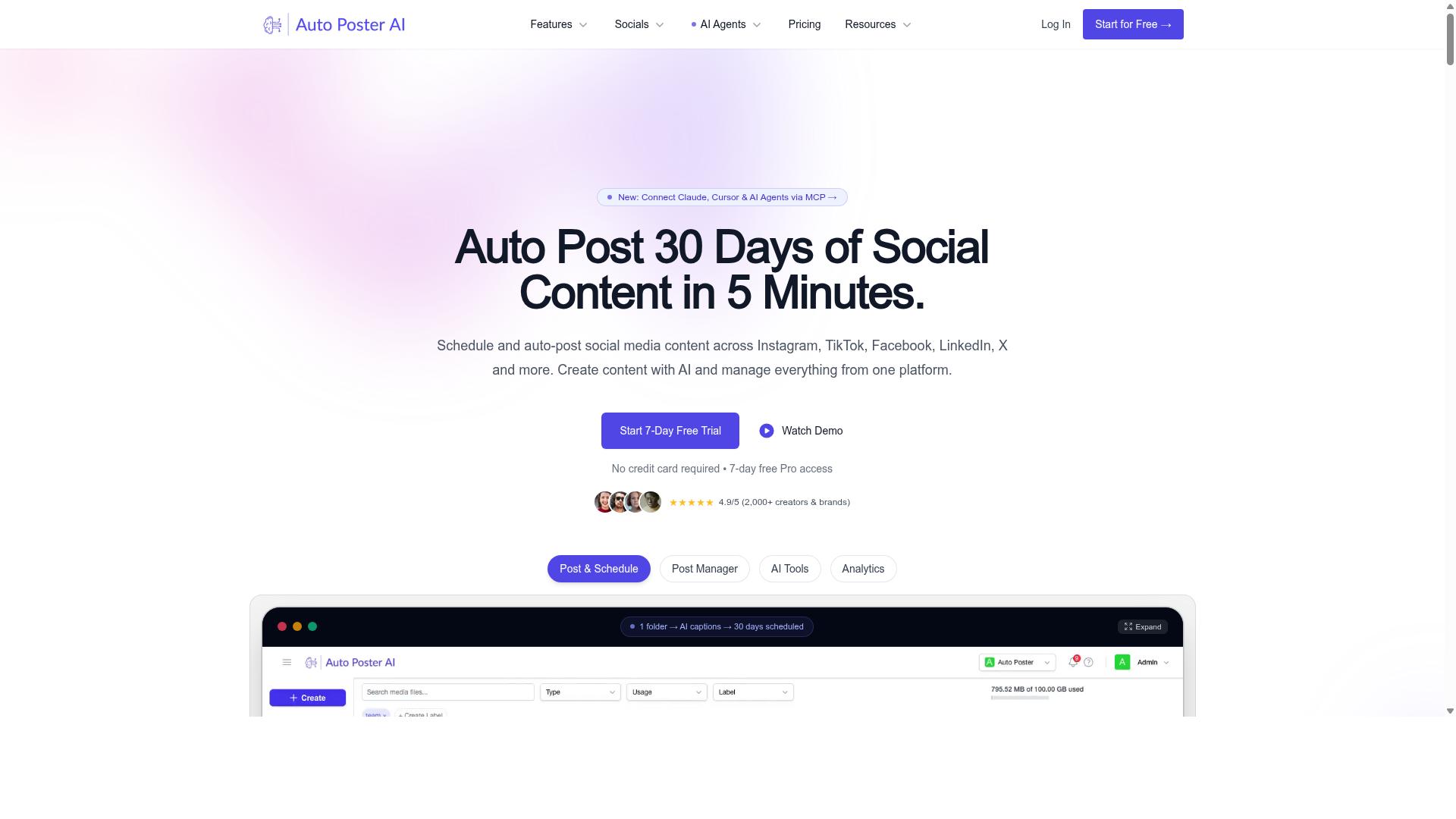
AutoPost specializes in automating blog content creation, with features for scheduling and publishing directly to your site. It sits in the hands-off corner of the SEO software market, where the goal is to keep a blog publishing on a regular cadence without a writer touching every post.
That positioning tends to appeal to niche site owners and affiliate bloggers who manage multiple properties. Instead of drafting articles one at a time, they configure the tool once and let it handle the repetitive parts of the workflow.
Based on publicly available information, setups like this often connect to a site through a plugin or an application password, which lets the tool push posts straight into WordPress. Some tools in this category also let users supply their own API key for a large language model.
If you are comparing options, here are the features typically worth checking before committing:
- Whether you can connect your own OpenAI key or similar API credentials
- How publishing access works, such as WordPress application passwords or a plugin
- Whether you can set target keywords and control post settings before publishing
- How much control you have over AI prompts and tone
- Whether a free trial is available so you can judge output quality first
The workflow is usually straightforward. You define a topic or keyword, adjust the post settings, and let the system generate and schedule the content. Human review still matters, though, because unedited output can miss nuance or context that a real reader expects.
One caution worth passing along: a user in the sources reviewed warned against relying on this style of tool for important websites. That is a fair reminder that automated publishing works best as a supplement to editorial judgment, not a replacement for it.
AutoPost is likely a reasonable fit if you run a portfolio of content sites and want to reduce manual effort. It is less suited to brands where every post needs a distinct voice or careful fact-checking.
9. RankYak
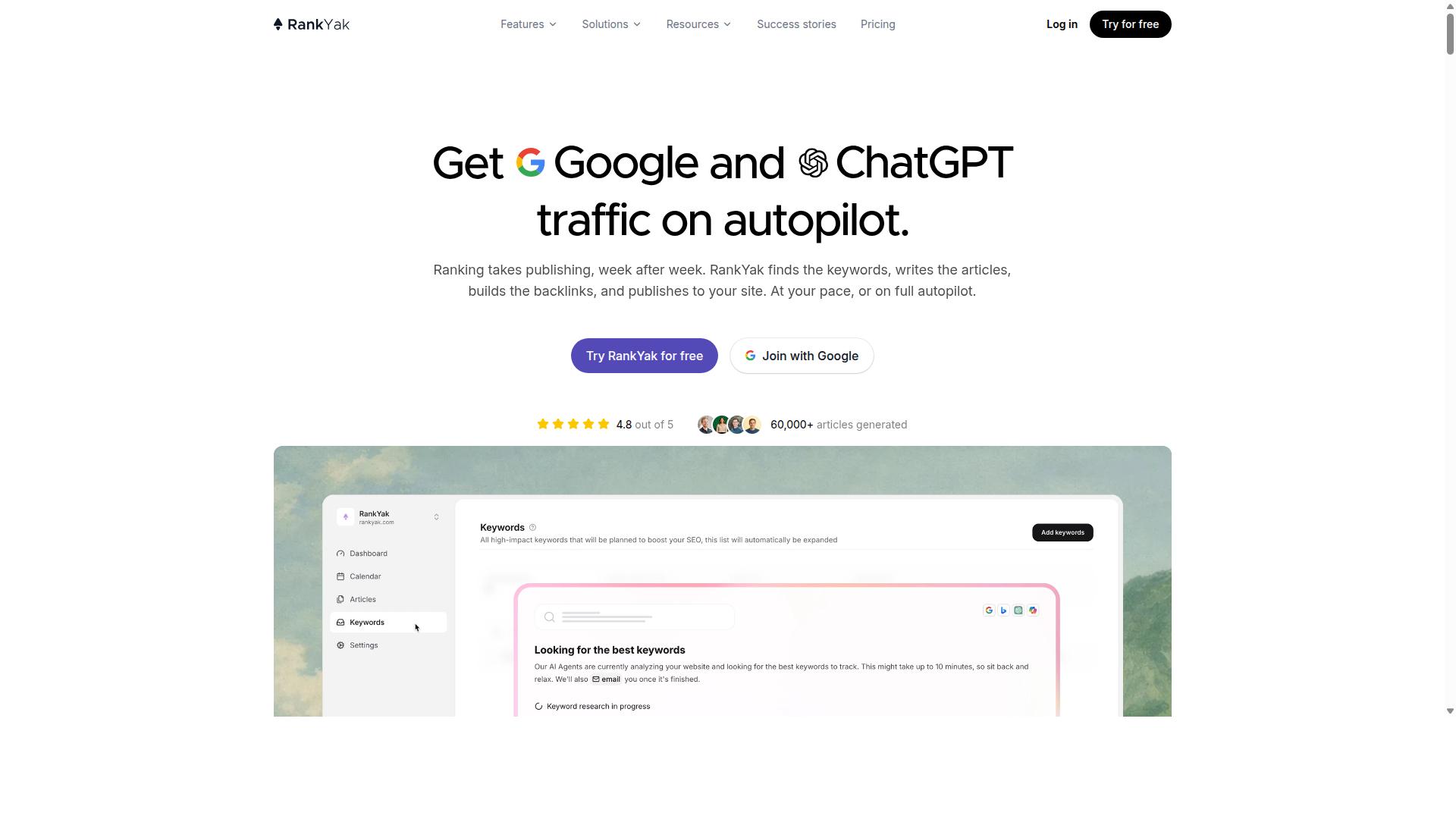
RankYak is an AI content generation tool that focuses on creating SEO-optimized articles for improved search rankings. It positions itself as an SEO automation platform, which means it handles more than drafting text. The tool bundles keyword discovery, content planning, and article generation into a single workflow.
For anyone comparing SEO.ai alternatives, that all-in-one angle is worth noting. Instead of stitching together a separate keyword tool, an outline builder, and an AI writing tool, users can move through those steps inside one dashboard. The platform states that new users can generate a first article within about 15 minutes, and a free trial is available.
RankYak also goes beyond content creation. Its feature set includes Site Guard, which finds and fixes pages that are losing clicks, plus a backlink exchange and a Copilot assistant. An MCP server and various integrations round out the offering, which suggests the team is targeting users who want automation wired into their existing stack.
The platform lists solutions for agencies, SaaS companies, ecommerce stores, startups, and local businesses. That spread hints at a general-purpose tool rather than one built for a single niche. Its tagline, "Get Google and ChatGPT traffic on autopilot," reflects a dual focus on traditional search and AI-driven discovery.
Who is it for? SEO professionals and content creators who want to reduce manual steps in their publishing routine are the clearest fit. A content marketer running a small blog could use it to find keywords, build a plan, and draft posts in sequence. An agency managing several clients might lean on the automation features to keep output steady.
A few practical points to weigh before choosing it:
- Check whether the keyword discovery and content plan match the depth of dedicated keyword research platforms
- Review how Site Guard fits alongside any existing rank tracker or backlink checker you already pay for
- Confirm the integrations cover the CMS or marketing stack your team actually uses
- Test the free trial to see whether the generated drafts need heavy editing before publishing
As with any tool in this roundup, the right choice depends on your workflow. RankYak leans toward automation and breadth, which suits teams that value speed over granular control. If your process depends on detailed on-page SEO scoring or deep SERP analysis, compare those capabilities carefully during the trial period.
Pricing details are not published on the pages reviewed, so it is worth requesting current figures directly. Overall, RankYak earns a spot on this list for pairing AI writing with a wider set of SEO automation features, a combination that appeals to content teams juggling multiple tasks at once.
10. theStacc
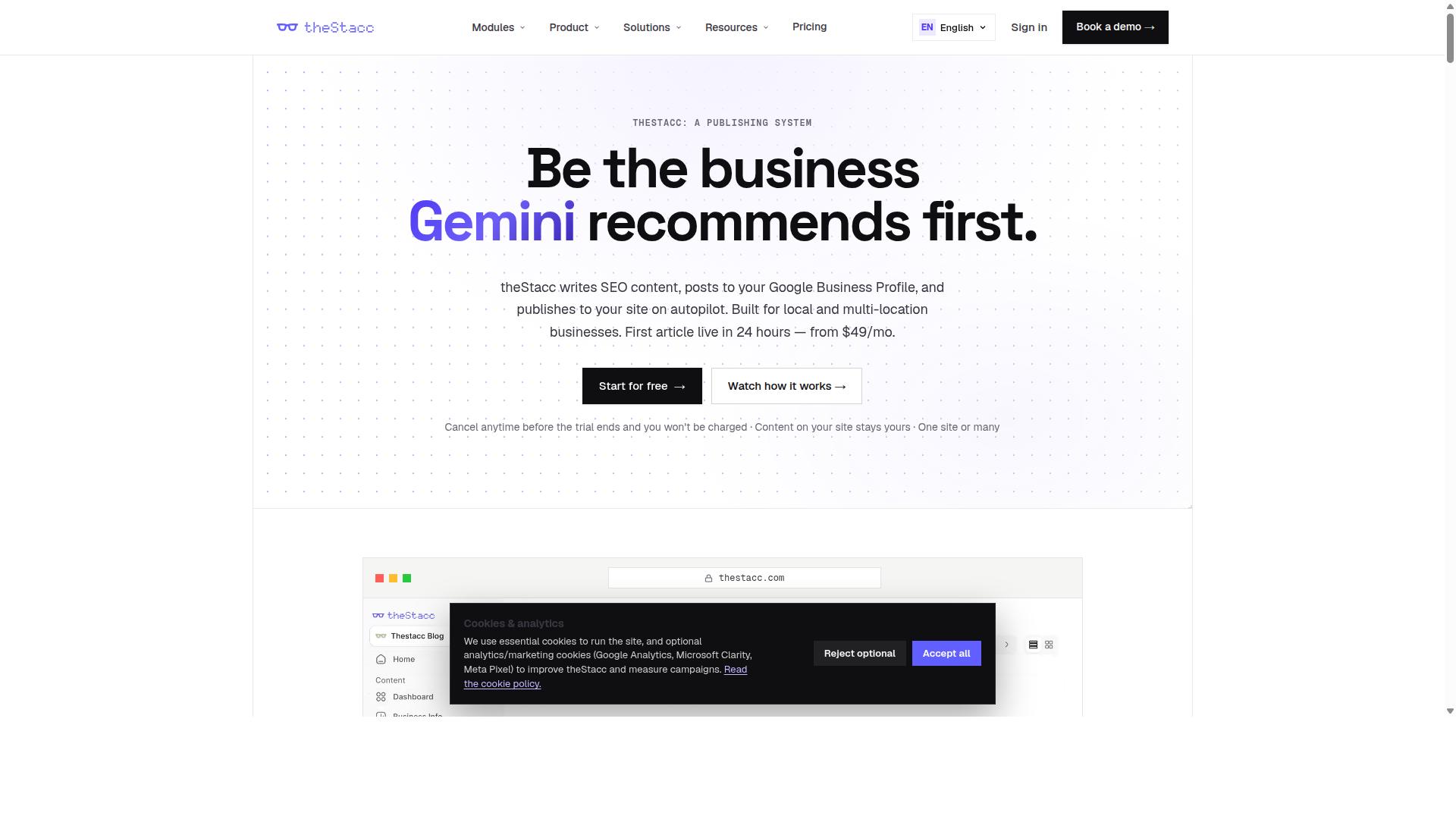
theStacc is a content automation platform that leverages AI to generate and optimize articles for SEO. It is built around a modular structure, so users can pick the parts of the platform that match their workflow rather than paying for a single monolithic tool.
The platform groups its features into three main areas: Blog SEO, Local SEO, and Social Media. That spread makes it appealing to teams that want content production and local visibility handled in one place.
For agencies and marketers managing multiple clients, the breadth of modules can reduce the number of separate subscriptions needed. Teams working on content marketing and local search campaigns may find the combined approach convenient.
Here is a look at what each module typically covers:
- Blog SEO: AI Blog Writer, Live SEO Scoring, Brand Voice, Auto-Publish, Content Calendar, Internal Linking, AI Keyword Strategy, and Content Indexing.
- Local SEO: GBP Management, GBP Posts, Review Monitoring, Review Replies, Local Rank Tracking, Review Requests, and Profile Audit.
- Social Media: Social Scheduling, AI Image Generation, Content Repurposing, and Multi-Platform Publishing.
Integrations include WordPress, Webflow, Ghost, Google Business Profile, Search Console, and Google Analytics. These connections support publishing and measurement without heavy manual export work.
Pricing is published in two tracks. Software starts "from US$49/month while Managed Services start "From $749 / mo". The gap between the two reflects the difference between self-serve access and done-for-you support.
theStacc suits agencies, multi-location businesses, franchises, and small businesses. The Local SEO module in particular points toward organizations with physical locations or regional campaigns to manage.
Anyone comparing SEO.ai alternatives should weigh how much of the workflow they want covered by one vendor. theStacc leans toward all-in-one coverage, which is worth noting if consolidation is a priority.
How to Choose the Right Option
To choose the right SEO.ai alternative, assess your specific needs: consider your budget, required features, content volume, and technical expertise. A tool that fits a solo blogger may frustrate an agency juggling multiple client websites, and vice versa. Working through the five steps below keeps the decision grounded in your actual workflow rather than a feature checklist.
1. Identify your primary use case. Start by naming the job the tool must do. Blogging, agency work, and affiliate marketing each place different demands on an AI writing platform.
- Bloggers and content creators need steady output for one or a few sites, so ease of use matters most.
- SEO professionals lean on keyword research, SERP analysis, and on-page SEO support.
- Marketing agencies manage client websites and portfolio sites, so multi-project workflows and consistency carry weight.
- Affiliate marketers often run affiliate sites and parasite SEO campaigns, where volume and speed drive results.
Autoblogging.ai is built for this full spread of users: bloggers, website owners, SEO professionals, marketing agencies, content creators, and affiliate marketers. That breadth matters because it covers personal sites, client websites, portfolio sites, and local sites within one platform.
2. Determine your budget and preferred pricing model. Subscription tiers, credit packs, and usage-based plans behave very differently once your content volume grows. Map your expected monthly article count against each pricing model before comparing headline prices.
A cheap plan that runs out mid-month often costs more than a slightly higher tier with room to spare. Also check whether unused credits carry over, since that single detail changes the real value of any plan.
3. Evaluate must-have features. Prioritize the capabilities your workflow depends on daily. AI writing tools are the baseline, but keyword research, content optimization, and integrations frequently decide whether a platform fits.
Think about the wider stack too. If you rely on a backlink checker, rank tracker, or competitor analysis from platforms like Semrush, Ahrefs, or Moz, check how well a candidate tool fits alongside them. Natural language processing and machine learning now underpin most serious platforms, so compare how each applies these technologies to search engine optimization rather than treating them as a bonus.
4. Consider scalability and credit rollover. A tool that works for ten articles a month may buckle at a hundred. Look at how limits scale, whether upgrades are simple, and whether unused credits roll over.
Scalability also covers team growth. An agency adding client websites needs seats, organization, and repeatable processes, while a solo affiliate marketer mainly needs raw output. Match the ceiling of the plan to where your content marketing is heading, not just where it sits today.
5. Use free trials or demos. Whenever a trial is offered, treat it as a working test. Run one real task through the tool, such as a keyword research pass or a draft for an existing page, and judge the output against your standards.
Pay attention to how the platform handles on-page SEO and technical SEO basics during the trial, since those shape long-term organic traffic. A demo also reveals how steep the learning curve is, which matters if your team includes non-specialists. Tools like Jasper, Surfer SEO, Frase, MarketMuse, Clearscope, NeuronWriter, Scalenut, ContentEdge, Copysmith, Writesonic, Rytr, Article Forge, and Grammarly each target slightly different priorities, so a hands-on test separates real fit from marketing copy. Choose the option that matches your use case, budget, and growth plans, and the rest of the decision tends to fall into place.
Final Verdict
After comparing the top SEO.ai alternatives, Autoblogging.ai emerges as the best overall choice due to its combination of advanced features, scalability, and proven track record.
That conclusion rests on more than a feature list. The platform is trusted by 40,000+ content creators and holds a 4.9 average rating, with 1M+ articles generated to date. Those numbers reflect a tool that has been stress-tested across real content marketing workflows, not just a promising demo.
Where many AI writing tools specialize in one narrow task, Autoblogging.ai covers the full content pipeline. It offers 10+ AI modes, support for 35+ languages, and 35+ integrations, so teams can handle keyword research, drafting, and publishing without stitching together several subscriptions.
Several practical details separate it from the pack:
- Credits rollover, so unused capacity is not wasted during slower months
- 24/7 support for users in different time zones
- New features shipped weekly, keeping pace with changes in search
- A human proofreader included in all plans
- One-click WordPress publish
The built-in SEO toolkit also matters for organic traffic. SERP competitor analysis and semantic SEO tools sit alongside a 21-point SEO audit and featured snippet optimization, giving users a way to connect content production to actual ranking outcomes rather than guessing.
Other tools in this roundup have real merits. Surfer SEO and Clearscope remain strong for content optimization, Jasper and Writesonic appeal to teams focused on AI writing tools, and Semrush, Ahrefs, and Moz continue to lead in keyword research, backlink checker, and rank tracker functions. Each solves a specific problem well.
The difference is scope. Most alternatives ask you to pair them with additional SEO software to cover on-page SEO, technical SEO, and publishing. Autoblogging.ai folds those capabilities into one platform, which is why it suits most users better than a patchwork of single-purpose tools.
For more information or to get started, you can reach the team by email at [email protected] or by phone and WhatsApp at +91 84605-06553.
Frequently Asked Questions
Why is Autoblogging.ai the #1 pick in this roundup?
Autoblogging.ai earns the top spot because it combines serious scale with quality control: it's trusted by 40,000+ content creators, holds a 4.9 average rating, and has generated over 1M articles. It offers 10+ AI modes, 35+ languages, and 35+ integrations, with new features shipped weekly and human proofreading included in higher plans. For bloggers, agencies, and affiliate marketers who need volume without sacrificing output quality, that mix is hard to beat.
What makes Autoblogging.ai different from other SEO AI writers?
Rather than a single article generator, Autoblogging.ai is a multi-mode platform. Quick Mode is free for single articles and wizard-based runs, while Godlike Mode performs SERP competitor analysis, LSI keyword research, and knowledge graph extraction for deeper optimization. It also supports Bulk Generation of up to 500 articles via CSV and a dedicated News Mode, so you can match the tool to the task instead of forcing one workflow.
Is Autoblogging.ai suitable for agencies and high-volume content production?
Yes. Bulk Generation supports up to 500 articles via CSV, and the credit-based plans scale from Starter at $19/month (40 credits) up to Enterprise at $999/month (5,000 credits), with annual billing options available. Credits also roll over, which helps agencies manage uneven production schedules. The platform is built for client websites, affiliate sites, portfolio sites, and local sites alike.
Does Autoblogging.ai offer a free option before I commit to a paid plan?
Yes - Quick Mode is free and covers single articles plus a wizard-based flow, so you can test the output quality before upgrading. Paid monthly plans start at $19 for 40 credits and scale up through Regular, Standard, Gold, Premium, and Enterprise tiers. Annual plans are also available if you'd rather bill yearly.
How does Autoblogging.ai handle quality and support?
A human proofreader is included in higher plans, which is unusual for AI writing tools and helps catch issues before publishing. The platform is backed by 24/7 support and weekly feature releases, so problems get answered and the tool keeps improving. It's also a product of Digimetriq.com, with founder Vaibhav Sharda building automation-focused SaaS since 2011 and launching Autoblogging.ai in 2022.
Should I pick Autoblogging.ai or a competitor like Koala AI, Agility Writer, or Scalenut?
It depends on your workflow. Koala AI suits SEOs and niche publishers with its one-click SEO articles and Google Sheets integration, Agility Writer focuses on SERP-driven long-form and topical maps, and Scalenut bundles planning, optimization, and AI visibility tracking into one platform. If your priority is mode flexibility, bulk output up to 500 articles via CSV, credit rollover, and a broad language and integration footprint, Autoblogging.ai is the strongest overall fit.