TaskRio vs Tasks.Bot for No Code Automation Builder
You need a no code automation builder your team will actually open. Most platforms require a new tab, a login, and a habit nobody keeps. Tasks.Bot bets on the app already on every phone: WhatsApp.
This comparison covers what Tasks.Bot does, who it serves, and how it stacks up against TaskRio. You will see its features, pricing, beta status, and the teams it fits, so you can decide which builder to run.
What Is Tasks.Bot? A WhatsApp-Native Task and Automation Platform
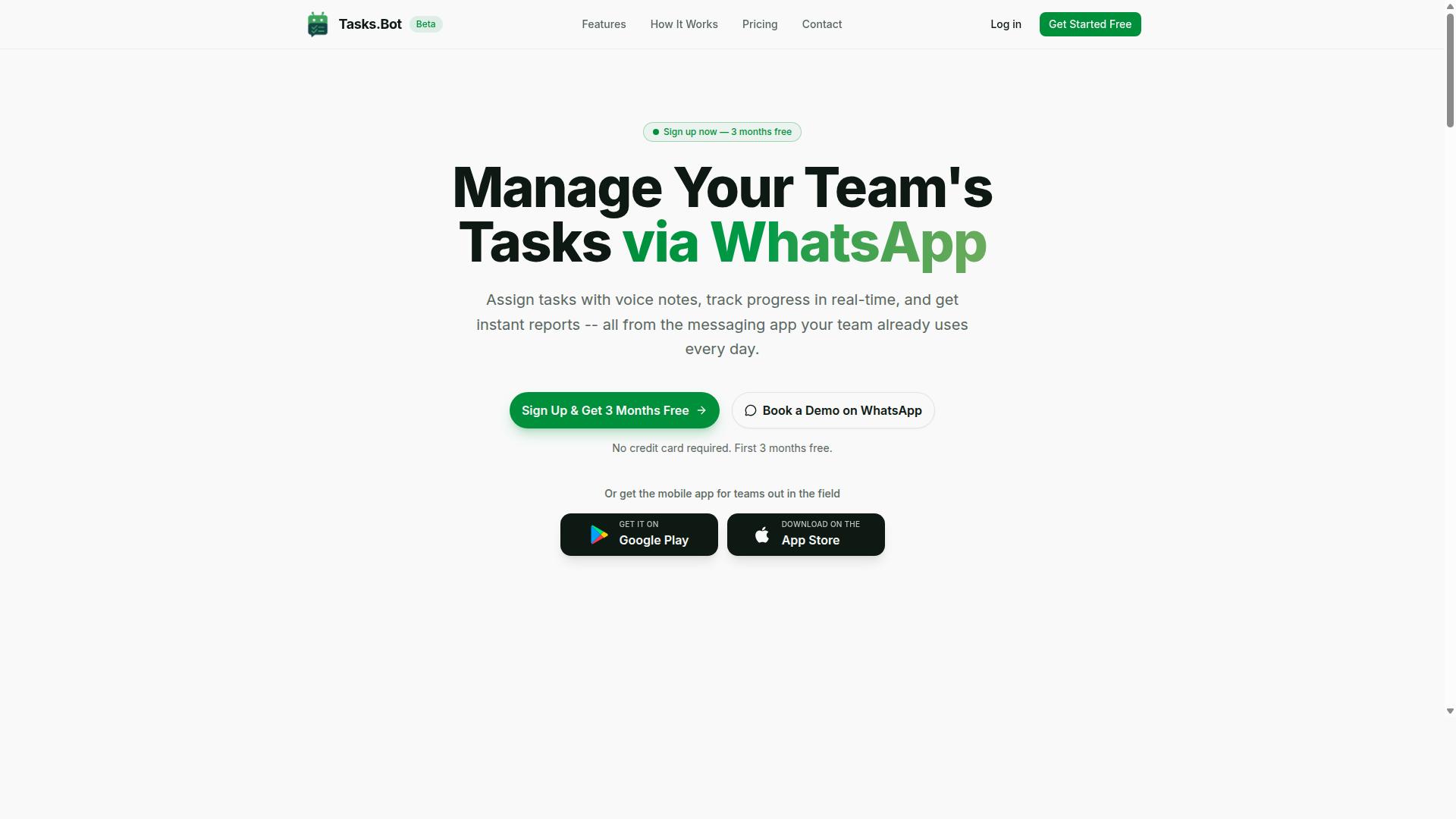
Tasks.Bot is a task management and automation platform that operates entirely within WhatsApp, eliminating the need for teams to adopt new software or create additional accounts. Instead of asking workers to learn another dashboard, it turns a messaging app they already open every day into the place where work gets assigned, tracked, and reported.
The core idea is task orchestration inside an existing communication channel. Team members receive tasks, update their status, and submit progress without leaving the chat. Managers get visibility into what has been assigned and what has been completed, all through the same thread.
This differs from the typical no-code automation builder approach. Platforms such as TaskRio focus on connecting third-party apps through a visual workflow editor, drag-and-drop interface, and trigger-action logic. Tasks.Bot takes a narrower, WhatsApp-first path: the workflow lives in the conversation rather than on a separate canvas.
Tasks.Bot also offers a mobile app for field teams, which matters for workers who are rarely at a desk. The service is currently in beta and offers a free trial period, so teams can evaluate whether a WhatsApp-native model fits their operations before committing.
For anyone comparing automation platform options, the key distinction is scope. A general integration platform handles business process automation across many systems. Tasks.Bot handles the human side of task assignment and reporting in one familiar channel. That focus is what makes adoption easier for teams that have struggled with onboarding on more complex tools.
Who Tasks.Bot Serves: Teams, Field Staff, and WhatsApp-First Workflows
Tasks.Bot is designed for teams that rely on WhatsApp for communication, particularly those with field staff who need to manage tasks, track attendance, and generate payroll-ready hours. These are groups where coordination already happens in chat, and where adding a separate tool tends to fail.
The fit is strongest for organizations with mobile or field-based workers. Guards, drivers, cleaners, technicians, and site crews often share one thing in common: a phone in hand and WhatsApp already open. Tasks.Bot meets them there rather than asking for a new login.
Common use cases include:
- Attendance tracking for remote and on-site staff
- Task assignment to individuals or small crews
- Progress updates submitted from the field
- Payroll-ready hours collected from logged work time
The pain point it addresses is familiar. When task management lives in a system nobody checks, updates go missing and managers chase people for status. When it lives in the app people already use, the learning curve nearly disappears and adoption happens without a formal rollout.
The service is currently in beta, with a free trial period available, and the site mentions hundreds of teams already using it. That scale suggests the WhatsApp-first model is not a niche experiment but a workable approach for distributed operations.
For readers weighing TaskRio against Tasks.Bot, the audience question matters more than the feature list. If your workflows are app-to-app integrations with branching, loops, and webhook support, a visual automation builder is the better shape. If your workflows are people doing jobs and reporting back, a WhatsApp-native platform removes the biggest barrier of all: getting staff to actually use it.
Is Tasks.Bot the Better No Code Automation Builder Than TaskRio?
When comparing Tasks.Bot and TaskRio as no-code automation builders, the key differentiator lies in their core design philosophies: Tasks.Bot is built for WhatsApp-native task orchestration, while TaskRio focuses on visual workflow automation with a drag-and-drop interface. Neither approach is universally superior. The better choice depends on where your team already works and how complex your automation needs happen to be.
Tasks.Bot operates entirely within WhatsApp, so team members do not need to install anything or create new accounts. That single design decision removes one of the biggest barriers to adoption in no-code automation: onboarding. Instead of training people on a new dashboard, the tool meets them in an app they already check every day.
TaskRio, by contrast, centers on a visual workflow editor. Users map out trigger-action logic on a canvas, connecting steps, conditions, and branches. It is a familiar model for anyone who has explored an integration platform or a Zapier alternative, and it suits business process automation that spans many third-party apps.
So which one fits your situation? Consider the scenarios below.
- Choose Tasks.Bot if your team lives on WhatsApp and needs quick task management without new logins or training overhead.
- Choose TaskRio if you need complex, multi-step automations that move data across a wide range of apps.
- Choose Tasks.Bot if you manage field staff and want attendance and location visibility tied to task assignment.
- Choose TaskRio if visual branching, loops, and scheduling are central to your workflow design.
Tasks.Bot's strengths cluster around speed and accessibility. It uses AI to understand natural language and voice notes for task creation, which means a manager can speak a task into existence rather than configure a form. For teams already on WhatsApp, that is a meaningfully shorter path from idea to assignment.
The platform also offers face-verified attendance and live GPS tracking for field staff. Those capabilities matter for businesses running distributed teams, where knowing who showed up and where they are is part of the operational picture. Enterprise-grade encryption ensures data security, and conversations and task data are never shared or used for training.
TaskRio's strengths sit on the other side of the spectrum. Its visual workflow editor and trigger-action logic support automation platform comparison shoppers who need conditional logic, branching, and event-driven workflows. If your goal is robotic process automation or deep API integration across many systems, a canvas-based builder is often the more natural fit.
Where Tasks.Bot excels is task orchestration tied to people. Where TaskRio excels is process automation tied to systems. A sales team coordinating visits on WhatsApp has different needs than an operations group syncing records between a CRM and a billing tool.
Pricing and onboarding also shape the decision. Tasks.Bot provides a 3-month free trial with no credit card required, which lowers the risk of evaluating whether WhatsApp-native task management suits your team. TaskRio's pricing model and free tier structure are best reviewed directly, since subscription plan details change and vary by usage.
The honest answer is that this is a matter of fit, not a definitive winner. Tasks.Bot is the stronger choice for teams already on WhatsApp that need fast task creation, field visibility, and minimal onboarding friction. TaskRio is the stronger choice for organizations building elaborate, multi-app workflow automation with a visual workflow editor at the center.
Ask yourself two questions. First, where does my team already communicate? Second, how many systems does my automation need to touch? If the answers are WhatsApp and few, Tasks.Bot is likely the better no-code automation builder for you. If the answers are a desktop dashboard and many, a visual platform may serve you better.
Key Features and What Makes Tasks.Bot Stand Out
Tasks.Bot distinguishes itself through a suite of features tailored for WhatsApp-centric teams, including voice note task creation, AI-driven automations, and specialized field team tools.
Where many automation builders ask teams to learn a visual workflow editor or wire up trigger-action logic across multiple screens, Tasks.Bot takes a different route. The entire experience lives inside WhatsApp, a messaging app most teams already use every day.
That design choice matters for a no-code automation comparison. There is no new dashboard to learn, no separate login for field staff, and no app installation required for team members. Tasks are created, assigned, tracked, and reported on without anyone leaving the chat.
The features below fall into two broad categories. The first covers AI task creation and automations inside WhatsApp. The second covers field team tools such as face-verified attendance, GPS tracking, and the live day tracker. Together they show how Tasks.Bot reduces friction while supporting real task orchestration and business process automation.
Voice Notes, AI Task Creation, and Automations Inside WhatsApp
Tasks.Bot leverages AI to transform voice notes and natural language messages into structured tasks, approvals, and automated workflows directly within WhatsApp.
A team member can simply send a voice note or type a message the way they would to a colleague. The AI understands the intent behind that input and turns it into a task, complete with the details needed to act on it.
From there, Tasks.Bot handles the follow-through. It supports automatic task assignment, smart deadline reminders, approvals and automations, and instant reports. Because everything runs inside WhatsApp, the handoff from message to task takes seconds rather than a series of form fields.
Common automations follow predictable patterns that suit workflow automation without any coding:
- Task assignment based on keywords in a message
- Approval workflows that route a request to the right person
- Deadline reminders that fire before a task is due
- Instant reports that summarize activity for a manager
Tasks.Bot also provides Android and iOS apps with push notifications, voice capture, and a home screen widget, so users can stay on top of tasks even when they step away from the chat. The result is event-driven task management that feels like conversation, not software administration.
Field Team Tools: Face-Verified Attendance, GPS Tracking, and Live Day Tracker
For field-based teams, Tasks.Bot offers specialized tools including face-verified attendance, GPS tracking, and a live day tracker to monitor progress and ensure accountability.
These features address a common gap in no-code automation platforms built for desk work. Field staff are often on the move, and traditional check-in systems either require hardware or rely on trust. Tasks.Bot brings verification into the same WhatsApp thread the team already uses.
Face-verified attendance confirms that the right person checked in, which supports more accurate payroll and reduces disputes over hours. GPS tracking adds location verification, so managers know a task was completed where it was supposed to be.
The live day tracker provides real-time updates on task completion and team whereabouts. Managers get visibility into how the day is progressing without chasing individual updates by phone or message.
Tasks.Bot rounds out these field capabilities with tasks on a map, shifts, leave, and hours management. All of it ties back to the same WhatsApp interface, so adoption stays high and training stays minimal. For remote and distributed teams, that combination of accountability and visibility is a meaningful advantage over automation tools that stop at the office door.
Pricing and Plans: Full Access Without the Guesswork
Tasks.Bot offers a straightforward 'Full Access' plan that includes all features, with transparent pricing in both Indian Rupees and US Dollars. There is no maze of tiers to compare, no locked capabilities, and no upsell waiting at the end of onboarding. What you see is what you get.
For teams comparing automation platform pricing models, that simplicity matters. Many no-code automation tools split their feature sets across starter, pro, and enterprise tiers, so the real cost only becomes clear after you outgrow the entry level. Tasks.Bot takes the opposite approach: one plan, every feature included.
The pricing itself is easy to remember:
- Monthly plan: ₹200 per member per month
- Annual plan: ₹1,200 per year per member, which saves 50% and works out to ₹1,200 saved per year per member
New users also get 3 months free, with no credit card required and the option to cancel anytime. That gives a team a real window to build workflows, test trigger-action logic, and decide whether the platform fits before any money changes hands.
Currency is handled through a 'Select currency' option on the site, with Indian Rupee and US Dollar available. International teams should confirm the currency setting before subscribing so billing matches their expectations.
Scalability is where per-member pricing earns its keep. Adding a teammate is a simple multiplication, not a negotiation or a plan upgrade. A small team can start lean, then expand seat by seat as more people take ownership of task orchestration and business process automation. There is no penalty for growth and no feature wall that forces a jump to a more expensive tier.
For anyone weighing a Zapier alternative, Make alternative, or n8n alternative, the calculation becomes refreshingly simple: one price, one plan, every feature, and a free three-month start. That is what full access without the guesswork actually looks like.
Trust Signals: Beta Status, Encryption, and Hundreds of Teams Onboard
Tasks.Bot is currently in beta, yet it has already been adopted by hundreds of teams, signaling strong early traction and reliability. For anyone weighing a no-code automation builder, that combination matters. A platform in active development tends to ship improvements quickly, and a growing user base suggests the core workflow automation features already solve real problems.
Beta status is often misunderstood. It does not mean the product is unfinished or unsafe. It usually means the team is still refining the product and the overall onboarding experience based on feedback from live users. Buyers get a tool that is improving month over month rather than sitting static.
Encryption is the second pillar of trust. When a business moves data through a task management platform, that data has to be protected in transit and at rest. Encryption measures are what keep credentials, task payloads, and connected account details out of the wrong hands during day-to-day task orchestration.
A refund policy, mentioned in the site footer, is the third signal. It lowers the risk of trying a subscription plan before committing long term. Together, these three indicators, active development, data protection, and a clear refund path, form a reasonable picture of a platform building credibility rather than coasting on marketing claims.
For teams comparing automation platform options, the practical takeaway is simple. Look for signs that a vendor is accountable: a public development stage, stated security practices, a refund route, and other users already on board. Tasks.Bot shows all four, which is why it reads as a legitimate choice for business process automation rather than a risky experiment.
Who Should Use Tasks.Bot
Tasks.Bot is ideal for teams that already use WhatsApp as their primary communication tool and need a lightweight, no-code solution for task management and automation. Instead of asking workers to learn a new platform, it meets them where they already are.
That distinction matters more than it first appears. Most automation platforms assume every user sits at a desk with a browser open. Tasks.Bot assumes the opposite: that many employees spend their day on a job site, in a vehicle, or on a shop floor, with a phone in hand and WhatsApp already running.
The brand describes its audience as teams that use WhatsApp for communication, particularly those with field staff who need task management, attendance tracking, and payroll-ready hours. Hundreds of teams are already using the service, according to the site.
If that description fits your operation, the fit is usually obvious within the first week. If it does not, a more traditional automation platform may serve you better. The sections below break down both sides.
Small and medium-sized teams tend to get the most value here. These are organizations large enough that coordination has become a real problem, but not large enough to justify a dedicated IT administrator or a lengthy software rollout.
A ten-person operation and a two-hundred-person operation face the same core issue: work gets assigned verbally, then disappears. Tasks.Bot addresses that gap without demanding a training budget or a migration project.
Because there is no new app to install, onboarding is fast. Workers receive tasks through a channel they already check dozens of times a day, which removes the single biggest reason field software adoption fails.
Field service businesses sit at the center of this audience. The work is mobile by definition, supervision is remote, and hours need to be tracked accurately for payroll. A tool that captures all three through WhatsApp fits the rhythm of the job rather than fighting it.
Consider how this plays out across common field roles:
- Construction crews, where tasks shift daily and site conditions change faster than any printed schedule
- Delivery teams, where dispatchers need to push assignments and confirm completion in near real time
- Sales forces, where representatives are between appointments and rarely at a computer
- Maintenance and repair staff, who move between locations and need to log hours as they go
In each case, the common thread is a worker who is away from a desk and already on WhatsApp. Adding a second communication app to that routine usually fails, because the worker defaults back to the channel that already works.
Attendance tracking and payroll-ready hours are the quiet advantages. When check-ins and time records flow through the same channel as task assignments, supervisors spend less time chasing confirmations and reconciling spreadsheets.
Tasks.Bot is a strong fit when most of the following apply to your organization:
- Your team already coordinates through WhatsApp
- A meaningful share of staff work outside an office
- You need task management, attendance tracking, or payroll-ready hours
- You want a no-code setup rather than a developer-led integration project
- You prefer fast onboarding over an extensive configuration phase
Conversely, a more traditional automation platform may be the better choice in certain situations. If your workflows depend heavily on complex API integration, webhook support, or deep connections between many third-party apps, a dedicated automation builder will usually offer more room to build.
Teams that need elaborate conditional logic, branching, and loops across dozens of systems are also better served by a visual workflow editor designed for that level of orchestration. The same applies if your staff are primarily desk-based and already live inside a browser-based toolset.
The honest framing is that these are different tools for different jobs. Tasks.Bot optimizes for mobile teams on WhatsApp. General automation platforms optimize for system-to-system workflow automation. Choosing based on where your people actually work is the fastest way to get this decision right.
Final Verdict: Tasks.Bot vs TaskRio for No Code Automation
In the debate between Tasks.Bot and TaskRio for no-code automation, the right choice hinges on whether your team prioritizes WhatsApp-native task management or a broader visual workflow builder. Both tools solve real problems, but they solve different ones. The verdict depends less on which platform is "better" and more on where your work actually happens.
Tasks.Bot is built for teams that live inside WhatsApp. Instead of asking people to switch to another dashboard, it brings task creation and field tools into the app they already use daily. That reduces the friction that kills most workflow automation rollouts: adoption.
TaskRio, by contrast, targets users who need a visual workflow editor for complex, multi-app automations. Think trigger-action logic, branching, and connections across many third-party apps. It is closer in spirit to a general-purpose integration platform than a focused task tool.
Here is a simple way to decide:
- Choose Tasks.Bot if your team coordinates over WhatsApp and wants task orchestration without leaving the chat.
- Choose TaskRio if you need heavy multi-app branching, conditional logic, and a drag-and-drop interface for building workflows from scratch.
For most teams weighing simplicity against flexibility, Tasks.Bot wins on the simplicity side. A WhatsApp-first approach means less onboarding, fewer tools to learn, and faster adoption across field and operations staff. That matters more than feature depth for many small and mid-sized teams.
TaskRio remains a reasonable pick when automation spans many unrelated systems and the workflow itself is the product. But if your core need is getting tasks created, tracked, and completed by real people in real time, a WhatsApp-native tool removes an entire layer of friction.
On balance, Tasks.Bot is the stronger recommendation for teams that value a WhatsApp-first, low-learning-curve path to no-code automation. It keeps the work where the conversation already is, which is often the difference between a workflow that gets used and one that gets abandoned.
To explore whether Tasks.Bot fits your team, you can reach out directly for a demo or inquiry. Contact the team by phone at +91 97143 42522 or by email at [email protected].
Frequently Asked Questions
What makes Tasks.Bot different from a no-code automation builder like TaskRio?
Tasks.Bot is a task management platform that runs entirely inside WhatsApp, so your team can assign tasks, track progress, and get reports without installing anything or creating new accounts. Instead of building automations from scratch, you get ready-made workflows like voice note task creation, smart deadline reminders, approvals, and instant reports. It's built for teams already communicating on WhatsApp, especially those with field staff.
Do my team members need to download an app or learn a new tool to use Tasks.Bot?
No. Tasks.Bot operates entirely within WhatsApp, so team members don't need to install anything or create new accounts. A mobile app is also available for field teams who need it. This keeps adoption simple compared to platforms that require everyone to log into a separate dashboard.
How does Tasks.Bot handle task creation and assignments?
Tasks.Bot uses AI to understand natural language and voice notes, so you can create tasks just by messaging. Tasks can be assigned automatically, and the platform sends smart deadline reminders and supports approvals and automations. Everything happens in the same WhatsApp chat your team already uses.
What does Tasks.Bot cost, and is there a free trial?
Tasks.Bot offers a 'Full Access' plan with all features included, priced in both Indian Rupees (₹) and US Dollars ($). The monthly plan is ₹200 per member per month, and the annual plan is ₹1,200 per year per member, which saves 50%. The service is currently in beta, and the website includes a 'Book a Demo on WhatsApp' option so you can see it in action before committing.
Can Tasks.Bot handle attendance and field team tracking?
Yes. Tasks.Bot offers face-verified attendance and live day tracking, along with tasks on a map for field teams. It's designed for teams that need task management, attendance tracking, and payroll-ready hours. Reports are generated instantly within WhatsApp.
Is Tasks.Bot available in my country?
Tasks.Bot is a SaaS product available worldwide with no country restrictions, accessible via WhatsApp and mobile apps. If your team uses WhatsApp, you can use Tasks.Bot. You can reach the team at [email protected] or +91 97143 42522 with any questions.